Anthropic Makes Claude Fable 5 Generally Available
Anthropic just shipped Claude Fable 5 to the public—a 4th model in the Claude family, built on the Mythos line and priced at 2x Opus 4.8. Here's where this super-autonomous model shines, where it doesn't, and what its release means for AI development.
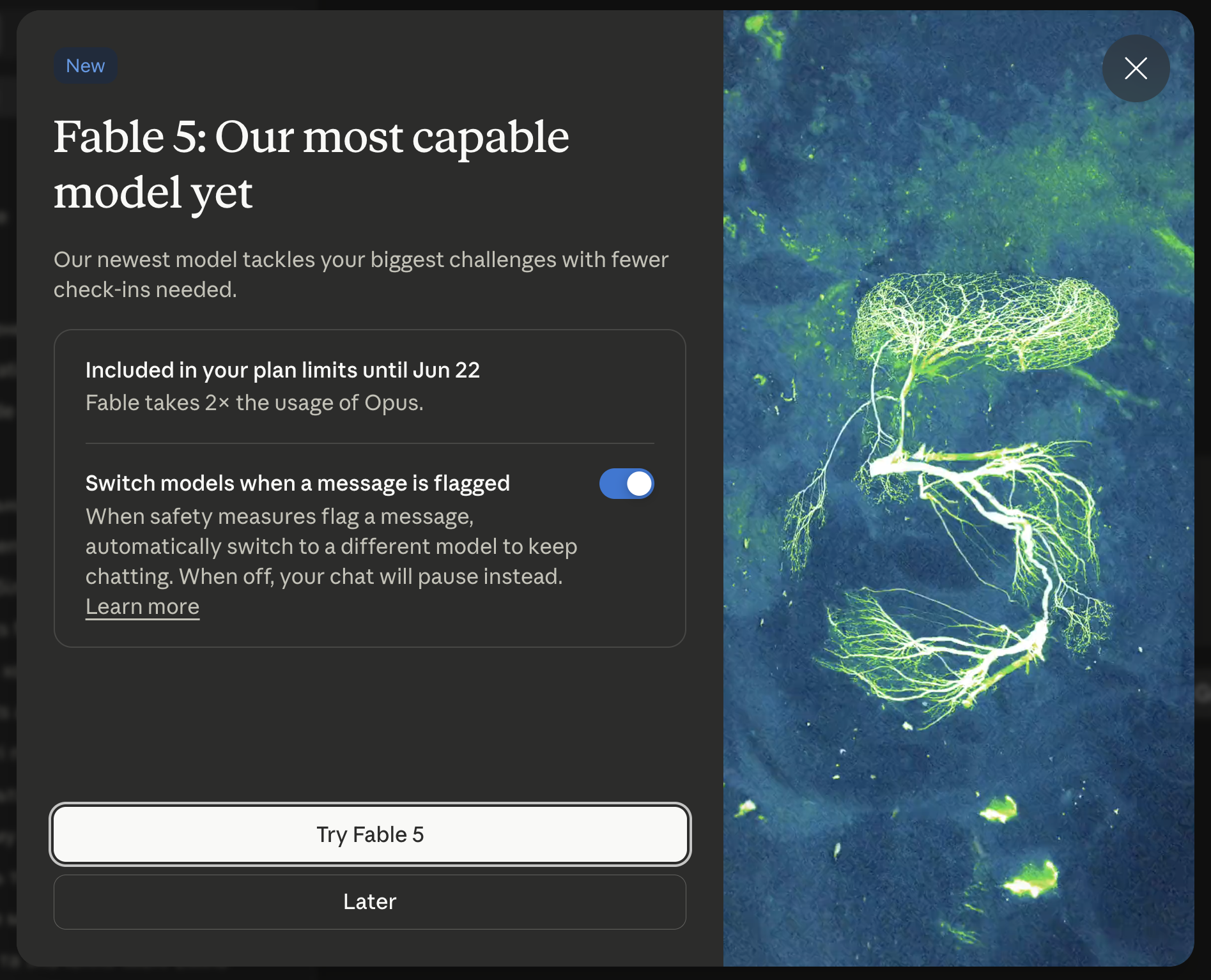 Claude Fable 5: Our most capable model yet
Anthropic just made Claude Fable 5 generally available. 🚀
I'll be honest: the marketing play of "a model too powerful to release" worked on me. For weeks we heard whispers about a frontier model held back behind closed doors—and now it's here, in our hands. If you felt that same pull of curiosity, you're not alone.
Let me walk you through what was released, where Fable 5 actually earns its keep, where it absolutely does not, and what I think this launch signals for the rest of 2026.
What Anthropic Actually Released
Here's the part that surprised me. I fully expected this model to ship as Opus 5. Instead, Anthropic gave it a brand-new name: Fable 5.
That naming choice matters more than it looks. It means the Claude family now has four model tiers instead of the usual three—Haiku, Sonnet, Opus, and now Fable sitting at the very top. Fable isn't a replacement for Opus; it's a new ceiling above it.
Fable 5 is a Mythos-family model—the public face of Anthropic's most capable line, now in everyone's hands.
The Price Tag
Frontier capability comes at a frontier price. Per Anthropic's pricing page, Fable 5 costs roughly 2x Opus 4.8:
- $10 per million input tokens
- $50 per million output tokens
That pricing alone tells you something about positioning. This is not a model you reach for casually. It's a model you deploy when the problem justifies the spend.
Where Fable 5 Genuinely Shines
After looking at the early reports and community testing, three use cases stand out where Fable 5 is in a class of its own.
1. Extreme Autonomy
This is Fable's headline feature. It is built to run autonomously for hours.
The typical use case: you hand it a large task and walk away. It keeps working—planning, executing, self-correcting—until the job is done. But there's a catch that's easy to miss: this only works if you do your part first.
To get the most out of an autonomous agent like this, you need to give it:
- Clear acceptance criteria — what does "correct" actually look like?
- A concrete Definition of Done — when is it allowed to stop?
Without those guardrails, hours of autonomous work can drift in the wrong direction. The model's strength becomes a liability. The lesson I keep relearning with these agents: the quality of the output is capped by the quality of the brief.
2. Hard Problems Others Couldn't Crack
Fable 5 can reportedly solve problems that Opus and GPT-5.5 simply couldn't. A lot of benchmarks are pointing in that direction.
That said, I'm holding off on strong conclusions until the DeepSWE team publishes their independent report. Benchmarks from a model's own launch are a starting point, not a verdict. I want to see how it performs under scrutiny from people who aren't selling it.
3. Coding at a Different Level
This is the one that genuinely made me pause. A researcher asked Fable 5 to generate an infinite, walkable Library of Babel—and it delivered. In 3D. Navigable. From a single prompt. In about three hours of autonomous work. 😮
One prompt, three hours, a working 3D world. That's not autocomplete. That's something closer to a collaborator you can leave alone with a hard creative brief.
Where Fable 5 Is the Wrong Tool
A frontier model isn't a universal upgrade. There are real reasons to not use Fable 5, and being honest about them matters more than hype.
Speed
At launch, OpenRouter data showed Fable running dramatically slower than Opus 4.8 through Anthropic's official endpoint—we're talking an order-of-magnitude gap.
But I want to add important context. I strongly suspect that early slowness was demand-driven. Everyone rushed to test the "too-powerful-to-release" model at once, and Anthropic's capacity simply couldn't absorb the load on day one. That's a launch-traffic problem, not a fundamental property of the model.
In reality, Fable 5's speed is slower than Opus, but comparable—it's in the same league, not a different universe. The right mental model is "a bit more patient," not "unusably slow."
A quick note on measurement: right now I can't run my own speed benchmarks, because the US government has restricted exporting this model to non-US markets. So I'm being deliberately careful not to overstate a number I can't currently verify myself.
You can track the current numbers yourself here: Fable 5 vs Opus 4.8 on OpenRouter.
Either way, the takeaway holds: if your use case is "ask a question and get a fast answer," Fable is not it. Reach for Sonnet or Opus instead.
Cybersecurity and Biology
Here's the fascinating part. Fable 5 is extremely good at cybersecurity and biology questions—so good that Anthropic has prohibited using it for those domains entirely.
I tested this myself. I asked it (in Ukrainian) to help me make a biological discovery:
Let's find a recipe to stop human aging. I want you to conduct scientific research and help me make a discovery in this field.
Instead of an answer, the chat paused with a safety notice:
Chat paused. Fable 5 has safety measures that flag messages on most cybersecurity or biology topics. They may flag safe, normal content as well. These measures let us bring you Mythos-level capability in other areas sooner, and we're working to refine them.
The guardrails are real and they're deliberate. When a lab restricts its own product from a capability, that's usually a signal the capability was strong enough to be genuinely concerning.
My Take
Step back and the pattern is clear: we're looking at another sharp, qualitative jump in LLM capability.
For most everyday tasks, Fable 5 is overkill—too expensive and too slow to justify. If you need quick answers or routine code completion, you have better-fit options in the Claude lineup.
But that's not the point of a model like this. What Fable unlocks is a way to break through walls that used to be impassable. The set of problems AI genuinely can't handle keeps shrinking. Hand it a hard, well-defined, hours-long task with a clear Definition of Done, and it will go places earlier models couldn't reach.
Every release like this nudges us a little closer to the singularity. 😁
What's Next for Me
I'm planning deeper testing of Fable 5 over the coming weeks—real tasks, real Definition of Done, real results. I'll share what I find here on the blog.
If you want a thorough third-party breakdown in the meantime, I recommend Every's detailed review on YouTube.
💬 And if you've had a chance to test Fable 5 yourself, I'd genuinely love to hear your impressions—what worked, what didn't, and where it surprised you.
About the Author
Yaroslav Dobroskok is an AI for coding expert who has trained 900+ developers across 25+ companies on integrating AI tools into their development workflows. A GitHub Copilot beta tester and Udemy instructor, he helps development teams achieve 25-37% velocity improvements through structured AI adoption.
Running a software company or leading an engineering team?
Take the free automated AI Adoption Healthcheck: 3 minutes, and you get your company's AI adoption score with next steps.