The Best AI Developers Won’t Write the Best Prompts. They’ll Optimize Cost per Task.
Learn how to optimize AI coding cost per task with model routing, S/M/L agents, autonomy budgets, validation and token usage tracking.
I burned through my OpenAI usage limit in 27 minutes.
It took three prompts.
I have used Codex as my main development tool for around eight months. The limits have always felt so generous that I had never used even half of my $20 subscription.
Then I gave Astra High three autonomous tasks and watched the remaining usage disappear.
That was a useful reminder: we are learning to build software in an economy that does not exist yet.
It made AI coding cost optimization feel less like a theoretical concern and more like a core developer skill.
Today’s subscriptions hide the real cost
Current AI subscriptions are heavily subsidized—especially for developers who keep coding agents busy with long, autonomous tasks.
Community measurements make the gap visible. One user estimated that a $100 Codex plan provided roughly $600–$675 of API-equivalent usage per week. A controlled test of the $200 plan estimated around $9,000–$9,700 per calendar month. Stress tests have produced estimates as high as $14,000 per month.
These are not API credits, and they are not OpenAI’s cost of providing the service. They are estimates of what the same token usage would cost at public API prices.
But the direction is clear: power users can currently consume far more than they pay for.
Like any good drug dealer, AI companies will eventually want their money back.
They may raise prices. They may reduce limits. They may move the best models behind usage-based billing. More likely, they will do some combination of all three.
When that happens, developers who never learned to care about token efficiency will feel disarmed.
The next competition between developers
Our profession is quickly turning into a new kind of game:
I can deliver this feature with AI for X dollars and Y hours.
The best developer will not necessarily be the person who writes the cleverest prompt or uses the strongest model.
It will be the person who can produce a correct result with the right combination of models, agents, context, validation and human attention.
The surrounding product matters too. In my Cursor vs Codex vs Claude Code comparison, the same model intelligence produces very different productivity depending on the UX, tools and agent workflow around it.
The important metric is not cost per token. It is cost per successful task.
Using a cheap model five times can be more expensive than using a frontier model once. Saving tokens is pointless if the result requires hours of rework.
I think about the real cost like this:
Cost per successful task = model usage + developer time + retries + review + rework
The word “successful” matters. A pull request that compiles but solves the wrong problem is not a cheap task. It is an unfinished one.
How to optimize AI coding cost per task
Over time, I have built a small AI coding cost optimization framework for my own development workflow. Here is what I use.
It is not about using the cheapest model everywhere. It is about spending expensive intelligence only where it creates enough leverage to justify the cost.
1. Choose the right model for each step
The easiest mistake is to choose one model for the entire task.
Feature development contains several different kinds of work. Requirements discovery, architectural decisions, implementation and review do not need the same level of intelligence.
I use three practical model tiers:
| Tier | Role | Typical work |
|---|---|---|
| S | Small, fast and cheap | Focused implementation, code search, simple research |
| M | Medium generalist | Requirements, orchestration and review |
| L | Frontier model | Architecture and high-impact decisions |
2. Design the execution strategy before writing code
Here is how I usually split a feature between those model tiers:
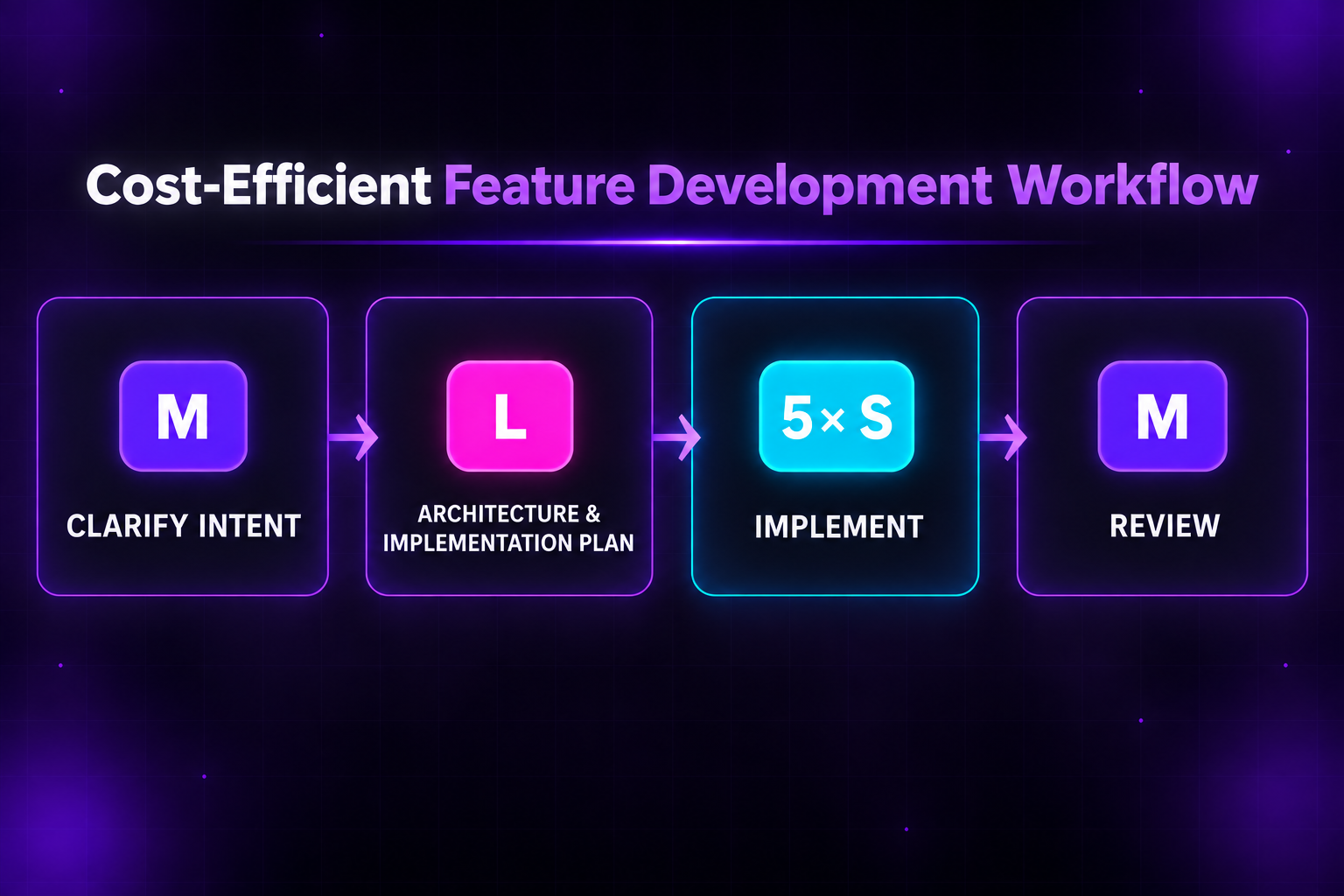 My simplified S/M/L workflow for reducing AI coding cost per task
First, I ask an M model to grill me on the requirements. It looks for ambiguity, hidden assumptions and edge cases, then records the answers in intent.md.
Next, an L model reads that document. It asks about anything still missing and produces a detailed implementation plan with three to five major steps.
Then an M model becomes the orchestrator. For each step, it spawns an S subagent with a narrow implementation task and clear acceptance criteria.
After every step, the orchestrator stops and reviews the result before moving on. At the end, it creates a separate M subagent for a full code review against intent.md. That subagent runs a review skill built for the repo, not a built-in /code-review.
The expensive intelligence is concentrated where it has the most leverage: clarifying architecture and making decisions that would be costly to reverse.
The implementation is split into narrow, testable steps that smaller models can handle. The medium model keeps the whole process coherent without writing every line itself.
This also reduces context pressure. Research, code search and implementation details stay inside focused subagents instead of filling the main conversation. I need /compact less often, and the orchestrator retains the decisions that matter.
3. Put cost efficiency in the agent’s rules
Most coding tools use medium or expensive models by default. If you never tell the agent to care about cost, it has no reason to route work differently.
I explicitly tell my main agent to optimize for cost efficiency.
For simple research, locating code or analyzing sample data, it should spawn an S-tier subagent. It should escalate to M or L only when the cheaper model cannot reliably complete the work.
I keep this instruction in my user-level CLAUDE.md and AGENTS.md, not only in repository-specific rules. That makes the same routing policy available in every task, across every repository.
Both files point to one canon file, so I edit the rule once. Here is that agent-agnostic setup for Claude Code, Codex and Cursor.
The reusable rule can be as simple as:
Optimize for cost efficiency. For bounded tasks such as research, code search and sample-data analysis, delegate to a small, fast model. Escalate only when the task requires stronger reasoning or the smaller model cannot complete it reliably.
That instruction saves both time and tokens. Small models are often not only cheaper, but faster.
4. Give agent autonomy a budget
Autonomy is useful until the agent confidently walks in the wrong direction for an hour.
Before a long task, define a budget: time, iterations, tokens or tool calls. If the agent cannot produce evidence of progress within that budget, it must stop and report what it learned.
For example:
If no test becomes green within 15 minutes, stop. Explain the current hypothesis, what you tried and what is blocking progress.
Without a stopping condition, a capable agent can keep generating plausible work almost indefinitely. That is where the largest invisible costs appear.
5. Build deterministic red-green indicators
“Looks good” is not a validation strategy.
Every autonomous task needs a deterministic signal that tells the model whether it is getting closer to the result:
- A failing test becomes green.
- Typecheck and lint pass.
- A screenshot matches the expected state.
- A benchmark stays within a defined threshold.
- A command produces the expected structured output.
These signals do more than improve quality. They reduce wandering, shorten feedback loops and tell the agent when to stop.
6. Measure AI coding token usage
You cannot optimize a cost you never inspect.
cc-usage reads local Claude Code and Codex sessions, breaks usage down by model and estimates the API-equivalent cost. It can also show five-hour and weekly subscription limits.
The dollar figure is informational: a subscription is not actually billed per token. But it makes expensive sessions visible and comparable.
Once a week, I want to be able to answer:
- Which tasks consumed the most tokens?
- Which model performed work that a cheaper model could handle?
- Where did an agent repeat research or implementation?
- Which task ran too long without a useful checkpoint?
- Did the expensive model reduce rework—or merely increase the bill?
That is how token optimization becomes a skill instead of a vague intention.
Practice before you are forced to
Today, you may not care. Your subscription may feel unlimited. Your company may pay the bill. The API-equivalent cost may be purely theoretical.
That is exactly why today is the best time to practice.
Learn to select the right model. Split work into stages. Route simple tasks to cheaper subagents. Limit autonomy. Create deterministic feedback. Measure the result.
If limits are cut by 10× tomorrow, you should not have to reinvent your entire workflow.
The future of software development will not be a competition over who can consume the most intelligence.
It will be a competition over who can turn that intelligence into working software most efficiently.
And the developers who learn to optimize cost per task now will have an unfair advantage later.
About the Author
Yaroslav Dobroskok is an AI for coding expert who has trained 900+ developers across 25+ companies on integrating AI tools into their development workflows. A GitHub Copilot beta tester and Udemy instructor, he helps development teams achieve 25–37% velocity improvements through structured AI adoption.
Connect on LinkedIn: https://www.linkedin.com/in/yardobr/
Running a software company or leading an engineering team?
Take the free automated AI Adoption Healthcheck: 3 minutes, and you get your company's AI adoption score with next steps.